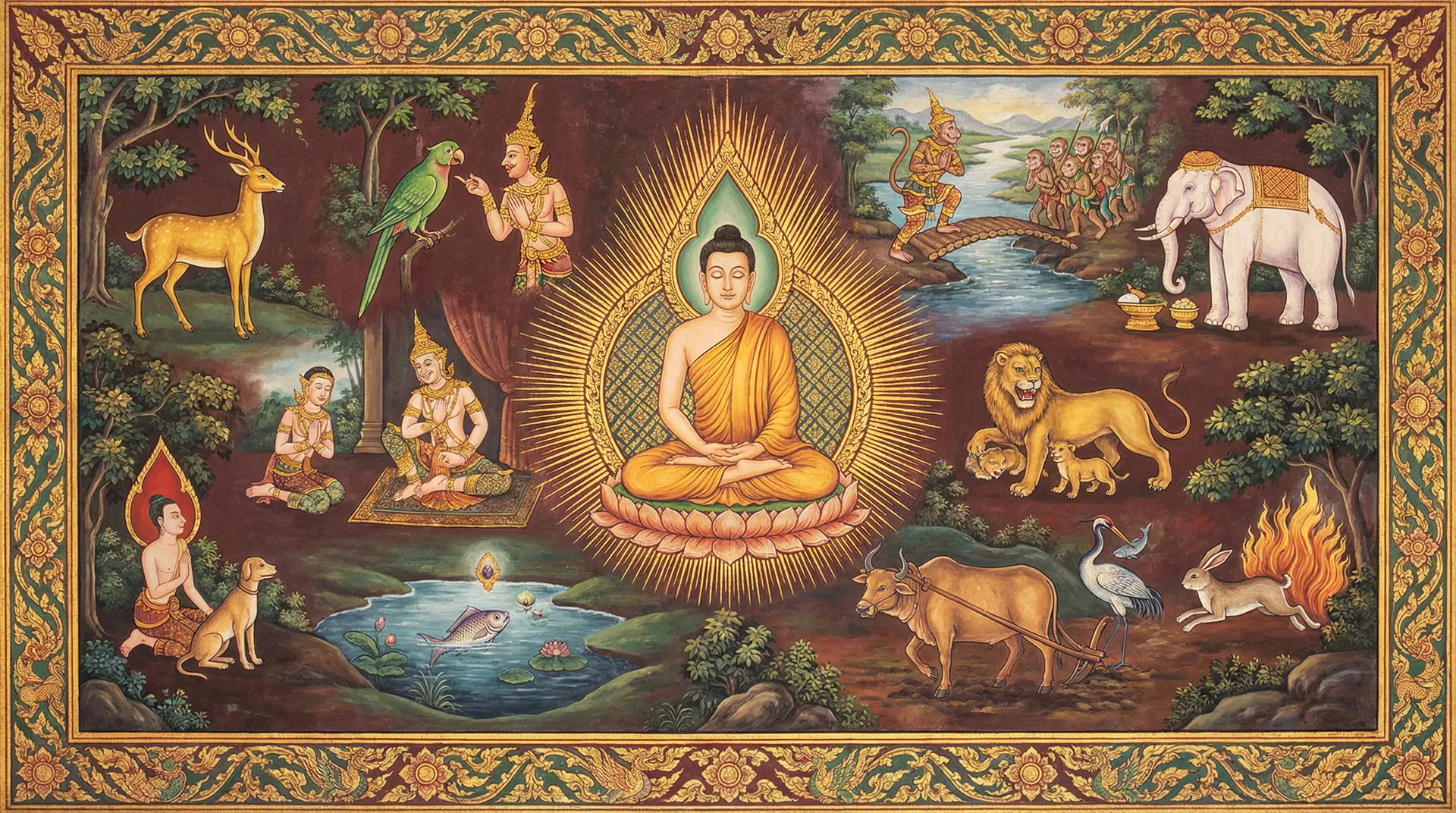
Mahasutasoma Jataka
Mahasutasoma Jataka
In the glorious city of Indapatta, the Bodhisatta was born as a prince named Mahasutasoma. From his youth, he was distinguished by his profound wisdom and his unwavering commitment to truth and righteousness. He possessed a knowledge of ancient lore and a keen understanding of the human heart, earning him the respect of all who knew him. His father, the King, often marveled at his son's extraordinary intellect and virtue.
One day, a wandering sage, a man of immense spiritual power but with a mind clouded by a misguided quest for ultimate knowledge, arrived at the royal court. He sought the King's permission to perform a great sacrifice, a ritual that, he claimed, would bring unparalleled prosperity to the kingdom. However, the ritual required the offering of a life, a young, healthy man, as a sacrifice to the gods. The King, a man of deep compassion, was horrified.
"Reverend Sir," the King said, his voice filled with distress, "I cannot consent to such a cruel act. To take a life for prosperity is a perversion of all that is good." The sage, however, was insistent. He spoke of ancient traditions, of divine mandates, and of the dire consequences if his ritual was not performed. The court was thrown into turmoil. Some argued for the ritual, fearing the sage's wrath, while others, led by Prince Mahasutasoma, vehemently opposed it.
Prince Mahasutasoma, seeing the fear and confusion in his father's eyes, stepped forward. He had studied the ancient texts and understood the true nature of such rituals. "Father," he said, his voice clear and resonant, "this sage misunderstands the path to true prosperity. The gods do not demand sacrifice of life; they bless actions born of compassion and truth. This ritual is not only cruel but also misguided."
The sage, angered by the Prince's defiance, turned his formidable power upon him. "You presume to know more than I, young prince? I shall prove your ignorance. If you are so wise, then tell me, what is the greatest offering a being can make?" The Prince, without a moment's hesitation, replied, "The greatest offering, sage, is not the life of another, but the offering of one's own desires, one's own ego, and one's own ignorance at the altar of wisdom and compassion."
The sage, taken aback by the depth of the Prince's response, continued to challenge him. He posed riddles, asked obscure questions, and employed all his spiritual prowess to confuse and defeat the Prince. But Prince Mahasutasoma, with his profound knowledge and unwavering clarity, answered each challenge with grace and precision. He explained that true prosperity comes from virtuous actions, from selfless service, and from the cultivation of inner peace, not from the shedding of blood.
He further elaborated, "The true sacrifice is the renunciation of greed, hatred, and delusion. It is the offering of one's own failings to the fire of self-awareness. When one understands that all beings are interconnected, the desire to harm another for personal gain vanishes." The sage, witnessing the Prince's unshakeable wisdom and the devotion of the people to his teachings, began to see the folly of his own path. His quest for knowledge had led him to a place of darkness, while the Prince's quest for wisdom had led him to the light of true understanding.
Finally, the sage, humbled and enlightened, bowed before Prince Mahasutasoma. "Your Highness," he confessed, his voice filled with remorse, "I have been lost in my pursuit of power and misled by ancient misinterpretations. You have shown me the true path. I renounce this cruel ritual and dedicate myself to the teachings of compassion and wisdom." The sage, transformed by the Prince's guidance, abandoned his destructive quest and became a follower of the principles of dhamma, spreading the message of non-violence and inner peace throughout the land. Prince Mahasutasoma, having saved his father's kingdom from a terrible fate, continued to rule with wisdom, proving that true strength lies in understanding and compassion, not in brute force or misguided rituals.
— In-Article Ad —
💡Moral of the Story
True prosperity and spiritual advancement come from inner transformation, compassion, and the renunciation of selfish desires, not from violence or external rituals.
Perfection: Truthfulness (Sacca)
— Ad Space (728x90) —
More Jataka Tales You May Enjoy
 141Ekanipāta
Mugapakkha Jataka
The Tale of the Mute Prince In the ancient kingdom of Mithila, ruled a just king named Dhanañjaya. H...
💡 True leadership is demonstrated through actions, courage, and compassion, not merely through eloquent speech.
3EkanipātaThe Bodhisattva and the Golden Deer
The Bodhisattva and the Golden Deer In the ancient kingdom of Mithila, nestled amidst emerald fores...
💡 Selfishness and the failure to help others lead to suffering. When we help others, we receive good in return.
38EkanipātaThe Jataka of the Great King of the Utmost Wisdom
In the city of Savatthi, during the time of the Buddha, the Bodhisatta was born as the wise prince n...
💡 Unwavering adherence to truth and virtue possesses a divine power that can overcome deceit and injustice.
 393Chakkanipāta
Kusa Jataka
Kusa JatakaIn the ancient kingdom of Mithila, ruled a benevolent king named Sudassana. His reign was...
💡 Patience, forgiveness, and righteous principles can overcome hatred and transform enemies into friends.
 484Pakiṇṇakanipāta
Kaccāni Jātaka
The Tale of the Wise Minister and the Foolish Brāhman In the prosperous kingdom of Mithila, King Ved...
💡 The human mind is the source of all potential and value; cultivating inner wisdom and contentment is the truest form of wealth.
 319Catukkanipāta
Maha-Ummagga Jataka
Maha-Ummagga JatakaIn the heart of the ancient kingdom of Mithila, under the reign of the wise King ...
💡 Profound intelligence, foresight, and logical reasoning are essential for effective leadership, capable of overcoming even the most daunting challenges and ensuring the prosperity and well-being of a kingdom.
— Multiplex Ad —